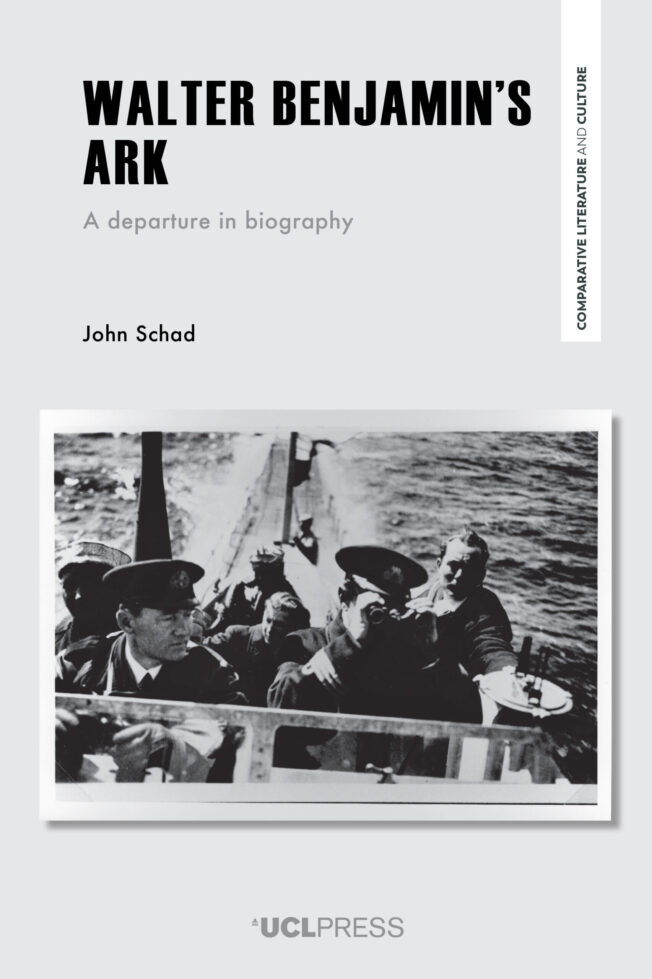

Walter Benjamin’s Ark
A departure in biography
John Schad (Author)
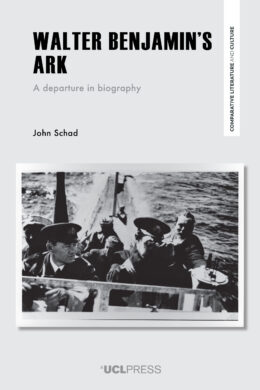
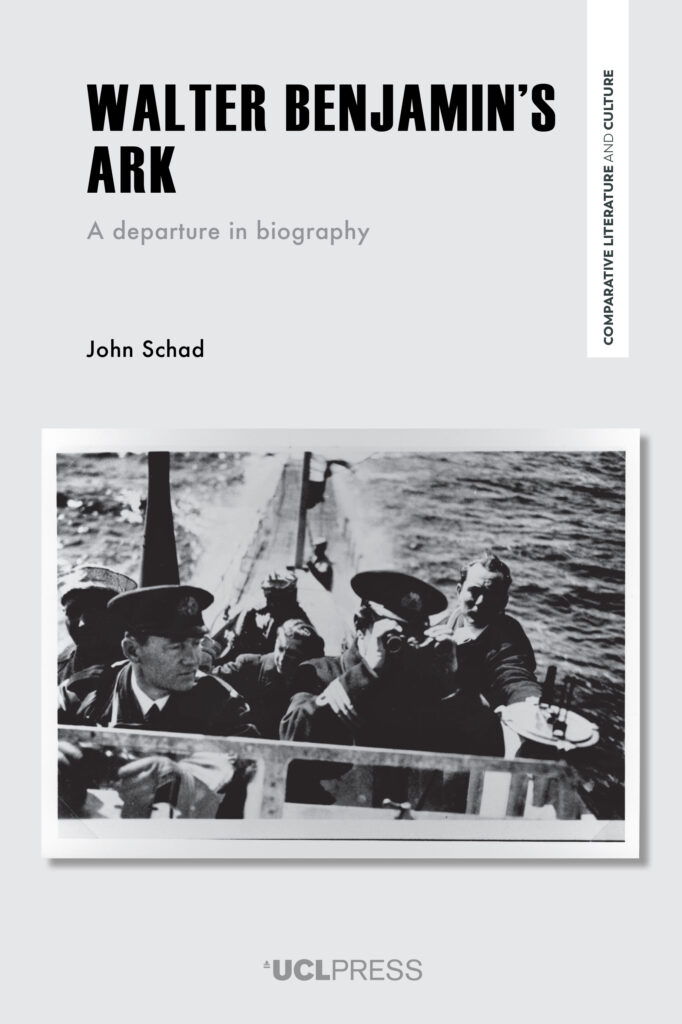
In July 1940, amidst fear of Nazi invasion, HMT Dunera left England. On board were a few British soldiers guarding over 2000 interned male Enemy Aliens, mostly Germans. Some of the internees were passionate Nazis, but most were Jewish refugees. Among them was Stefan Raphael Benjamin, the estranged child of the German-Jewish intellectual, Walter Benjamin.
Cue Walter Benjamin’s Ark which re-reads the life and work of Walter Benjamin via the curious life of his only child. The focal point is Stefan’s dramatic voyage from England to Australia in 1940, a voyage rich in intellectual suggestion, shared as it was with obscure men with famous names such as Wittgenstein, Kafka, Marx and Wilde. Central to the book is the one substantive text that can be ascribed to Stefan: Benjamin’s meticulous transcription of Stefan’s utterances as an infant. This fascinating text has been largely overlooked, despite the insistence of Benjamin’s biographers that ‘it continued to play a role in Walter Benjamin’s writing until the end of his life’. This book thus seeks not only to bring into view the intriguing figure that is Stefan but also to identify him as that most crucial of Benjaminian spectres, namely, the secret ‘you’ or addressee of Benjamin’s writings.

Hosts, Hospitals and Hospitalities
Susana Araújo, Catarina Nunes de Almeida, Santiago Pérez Isasi,
27 July 2026
Creative Critical Interventions for Social Justice
Natasha Tanna, Abeyamí Ortega Domínguez, Hakan Sandal-Wilson,
04 February 2026
Translation Studies before ‘Translation Studies’
Kathryn Batchelor, Iryna Odrekhivska,
15 January 2026


Contemporary Afro-Brazilian Short Fiction
Ana Cláudia Suriani da Silva, Julio Ludemir, Maria Aparecida Andrade Salgueiro,
03 September 2024
Walter Benjamin’s Ark
A departure in biography
Series: Comparative Literature and Culture
Publication date: November 3, 2025
Open Access PDF ISBN: 9781800089709
Paperback ISBN: 9781800089693
Hardback ISBN: 9781800089679
Trim size (hardback): 23.4cm x 15.6cm
Trim size (paperback): 23.4cm x 15.6cm

In July 1940, amidst fear of Nazi invasion, HMT Dunera left England. On board were a few British soldiers guarding over 2000 interned male Enemy Aliens, mostly Germans. Some of the internees were passionate Nazis, but most were Jewish refugees. Among them was Stefan Raphael Benjamin, the estranged child of the German-Jewish intellectual, Walter Benjamin.
Cue Walter Benjamin’s Ark which re-reads the life and work of Walter Benjamin via the curious life of his only child. The focal point is Stefan’s dramatic voyage from England to Australia in 1940, a voyage rich in intellectual suggestion, shared as it was with obscure men with famous names such as Wittgenstein, Kafka, Marx and Wilde. Central to the book is the one substantive text that can be ascribed to Stefan: Benjamin’s meticulous transcription of Stefan’s utterances as an infant. This fascinating text has been largely overlooked, despite the insistence of Benjamin’s biographers that ‘it continued to play a role in Walter Benjamin’s writing until the end of his life’. This book thus seeks not only to bring into view the intriguing figure that is Stefan but also to identify him as that most crucial of Benjaminian spectres, namely, the secret ‘you’ or addressee of Benjamin’s writings.
‘Those readers familiar with Walter Benjamin’s work will enjoy the recognisable current of references woven into John Schad’s book. Others will appreciate the author’s playful use of literary references while being encouraged to discover an important philosopher (Benjamin himself rejected the term) who will make them see our world afresh’
The Morning Star
‘“The Angel of History,” philosopher Walter Benjamin claims, is witness not to a “chain of events” but rather “one single catastrophe which keeps piling wreckage … in front of his feet.” No doubt this “pile of debris … [which] grows skyward” consists mainly of human wreckage, the dead; but, as John Schad’s weird and hallucinatory new book, Walter Benjamin’s Ark, demonstrates, it also includes language, texts, the very ability of human beings to communicate. The catastrophe that is mid-twentieth-century history, in particular, reduced texts to a “huge-and-disorderly-heap-of-unsorted BOOKS, a kind of rubble,” such that “words had been muddled,” often in disastrous ways.
Walter Benjamin’s Ark brilliantly picks its way through that rubble, trying to salvage something from the cataclysm. It pieces together an upcycled collage of historical fragments, philosophical and literary texts, impossible conversations, in order to tell the imagined story of Walter Benjamin’s son, Stefan, and his journey as a deportee from England during the Second World War.’
Everybody’s Reviewing
‘A piece of innovative and meticulous scholarship.’
Inside Story
‘Stefan’s biography is one forgotten struggle, and its resurfacing is an illuminating one.’
The Review of Democracy
‘Meticulously researched and imaginatively rendered’
TLS
‘Walter Benjamin’s Ark is the story of a imaginary voyage spun out of a real one, of the ship Dunera that that carried Walter Benjamin’s son Stefan from Britain to Australia. The voyage is a compound of many other voyages, on different fictional and historical wavelengths, its passengers a collection of stowaways. stand-ins, impostors, understudies, namesakes and doppelgängers, including a Wittgenstein, a Kafka and a trio of Wildes. By turns séance, vaudeville routine and somnabulistic seminar, and constantly invaded by refugee voices from the written words of Benjamin and others, this is a haunting, haunted voyage through a dream history of the Second World War. Once more, John Schad has come up with a wholly new, and utterly unforgettable way of writing history.’
Steven Connor, King’s College London